


New and Old Friends at South Lakes Safari Zoo
- thora50
- Sep 28, 2024
- 7 min read
I am lucky enough to be a season ticket holder at the zoo, and I received an email saying there was a special tour of the Rhinos last weekend. With the weather being favourable, I set out and headed for Dalton on Saturday. I had got the Rhino day wrong, it was Red Panda day on Saturday. So I said yes please and joined the Red Panda tour. As far as I could see there were just two of them, and they had to be kept apart as they were closely related and of an age when breeding begins. The male red panda was the most sociable as far as we were concerned and spent most of the time sunning himself high up on a platform. They like to be up high.


The Red Panda is slightly bigger than the domestic cat with distinctive russet markings and ringed tail.
They are skilled acrobats and mainly live in the trees. They are primarily herbivores and their main habitat is in the Eastern Himalayas. Their long bushy tails are used for balance and for warmth to wrap round them in winter. The word panda comes from the Nepalese word 'ponya' which means bamboo or plant eating animal.
Their status is endangered.

Loss of their natural habitat ( nesting trees and bamboo) is causing a decline in populations. They are often killed when they get caught in traps used by locals for other animals eg pigs. They are also poached for their pelts in Myanmar and China.
WWF are working with locals to provide and alternative method for making an income eg Yak dung briquettes ( used instead of cutting down of wood used by the red panda). And introducing tourism as a means of making a living.

They have quite sharp teeth

They like being up high
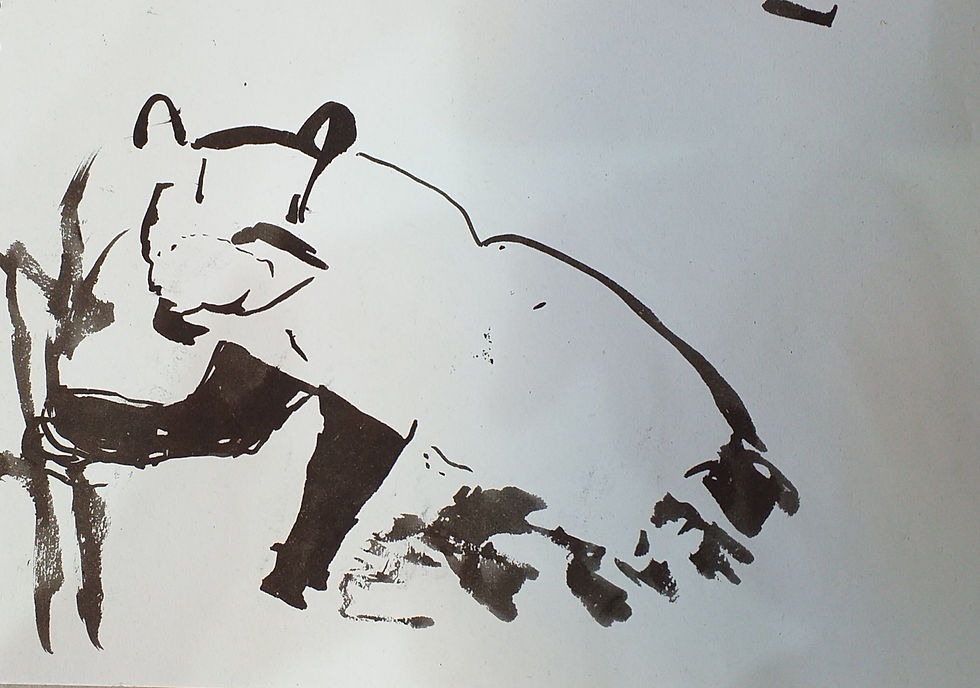
They eat bamboo

The next animals that I hadn't drawn before were giraffes. There are two subspecies of giraffe at South Lakes Safari Zoo, the Rothschild's Giraffe and the Kordofan Giraffe.

I think the above giraffe is a Kordofan Giraffe

I think these are Rothchild's Giraffes
There are nine subspecies of giraffe.
Giraffes are known as keystone species, which means they have a significant impact on their habitat. They do this because they are so tall and browse the tops of trees, which then regenerate creating micro habitats for other species. They distribute nutrients ( and seeds) through their dung and urine.
They live in open woodlands, wooded grasslands ( or shrublands and savannah). They eat leaves and twigs from over 100 different trees and shrubs, but prefer acacia. They also eat grass and fruit.
They are the tallest land animal in the world, up to 5.5m high and weighing nearly 2 tonnes. The horns on their head are ossicones. These may be used in fighting and sexual behaviour..
Their status is vulnerable.
They are herbivores, living mostly in eastern and southern Africa. Again habitat loss is a big threat as well as hunting and poaching. Every giraffe has its own unique spot pattern.
I have drawn Rhinos (Southern White Rhinos) before. I like their leathery skin and folds. They seem very peace loving in the zoo, but I wouldn't like to be in their sights out in the bush.
When I got out my sketching pad, two other young girls and their fathers were intrigued....I gave them each a sheet and some pencils. This is what one of them produced. I thought it looked slightly like the small images it was suggested I try. I was wondering about shrinking my images with the photocopier and using them as silhouettes.


In this drawing are the other species in the same enclosure as the Rhinos. They are ( left to right ) Plains Zebra ( Equus Quegga ), Blue Wilderbeast and Nyala.


Rhinos are another keystone species. They wallow in mud and water, creating natural waterholes that other animals can use. They eat a lot of plants and recycle nutrients through their dung and urine. Their dung creates more invertebrates, which are eaten by small birds and mammals, thus boosting their populations. Many species can be protected by protecting the large range roamed by rhinos.
Industries destroying habitats are:
mining
quarrying
fossil fuel production
agriculture
infrastructure for the above.
Infectious diseases can also be transmitted by livestock.
The oxpecker is a bird that has a symbiosis with rhinos. They eat insects and ticks while on the rhino, while alerting them to danger. These birds are known as 'Askari wa kitaru' meaning the rhino's guard. The White Rhino is a grazer while the Black Rhino is a browser (trees and shrubs).
Rhinos lead largely solitary lives. Mother and calf stay together for 2-4 years. Their lifespan is 30 - 50 years and their gestation is 15 - 16 months.
They can appear grumpy, but they have bad eyesight, which may account for the fact that they sometimes appear to charge without apparent reason. African rhinos, Black Rhino and White Rhino inhabit savannah, forest and shrub habitats.
Four out of the five species of Rhino are endangered. White Rhinos are 'near threatened'.
The zoo keeper who gave us the talk, told us that the breeding program designed to distribute the genes of rhinos in captivity is greatly reduced now and has been made much more difficult since Brexit. Whereas before rhinos were shipped abroad to other breeding programs regularly, since Brexit they are now just rotated within the British Isles.
The keeper said she had been out to Africa with the conservation program to find out amongst other things, about the tracking and use of electronic collars for rhinos. This is done to aid conservation when the rhinos are dehorned to make them less attractive to poachers. However they found that those rhinos without horns who had obvious trackers were still killed, because they alerted the rangers to the whereabouts of the other rhinos. They are now trialling smaller, less obvious devices alongside dehorning. But also, sadly, when one area is tracked and protected the poachers just move on to another area. There is the problem of corruption in policing poaching and the underlying socio-economic reasons of poverty and 'easy money'.
Poaching occurs because the rhino horn ( and other parts) are used in traditional Asian medicine. How can you dispel the myth that is ingrained into the far eastern society that uses this 'medicine'. Not an easy task.
The Lynx is one of my favorites. This is partly because I am very fond of ( big ) cats and they look very cuddly with their soft fur and beautiful hairy feet and legs. In real life I think they have sharp teeth and claws. Also partly because I got some nice prints from drawing the Lynx last time, looking quite aloof, which seems to be a cat trait!


Image from an earlier visit.
The definition of Lynx given by Wikipedia is " A Lynx is any of the four exant species within the medium sized wild cat genus, Lynx."
There are four species of Lynx:
Eurasian Lynx
Canada Lynx ( at South Lakes Safari Zoo)
Iberian Lynx
Bobcat.
The Lynx has a short tail, tufts of black hair on the tips of their ears, large padded paws for walking on snow and long whiskers on their face. They have a "ruff" below their chin. They have long fur which is mottled, with white fur on their chest and bellies and inside of their legs. The smallest species are the Bobcat and Canada Lynx.
The four living species of Lynx evolved from Lynx issiodorensis, which lived in Europe and Africa during the late Pliocene to early Pleistocene. (Approximately 5.4 - 2.4 million years ago). Historically the Canada Lynx was found from Alaska, across Canada and into northern USA. It has now been successfully reintroduced into Colorado. It has been deemed a threatened species in the lower 48 States of the USA.


Lynx are usually solitary but sometimes travel and hunt in small packs. Mating is late winter and once a year the female gives birth to between 1 and 4 kittens. The young stay with their mother for more than one winter ( around 9 months). They create their den in crevices or under ledges. They are carnivorous, feeding on deer, hares, fish, foxes, sheep, squirrels, mice, turkeys and birds and goats. They eat ptarmigans, voles and grouse.
I have been involved in supporting orangutan rescue for a few years now. The zoo has a few species of primate, but I found the Spider Monkeys delightful and even interactive while I was drawing them.


Spider Monkeys belong to the Ateles genus and are characterised by long arms and hook like hands. They also have long hair and long tails, which can be used as a fifth limb for grasping.
They like a tree based lifestyle. They live in large groups , called troops containing 20 to 100 individuals. They use voice calls, facial expressions and body postures to convey messages and emotions to each other. I noticed this - when I had stood quietly sketching for a while, they stretched out and even glimpsed gingerly at me.

They have polygamous mating habits and form short-lived temporary parings called consortships. Their natural habitat is in the tropical rainforests of Central and South America.
They eat a diet rich in fruit. They also eat flowers, bark, seeds, leaves and even insects. They have been known to eat bird eggs, small animals and honey. They play an important ecological role of seed dispersal.
They typically live for 22 years, their gestation period is 7 1/2 months and female spider monkeys produce one offspring each year or every two years. Baby Spider Monkeys are born fully furred and initially live on their mother's stomachs, before riding on their mother's back. Females mature at 4 years, males at 5 years.
There is a strong bond between mother and young.


Sadly Spider Monkeys are endangered. The brown-headed and brown Spider Monkeys are critically endangered, which means that they are on the brink of extinction.
I found them charming, engaging and interesting to draw. I look forward to seeing them again at Dalton.


Comments